

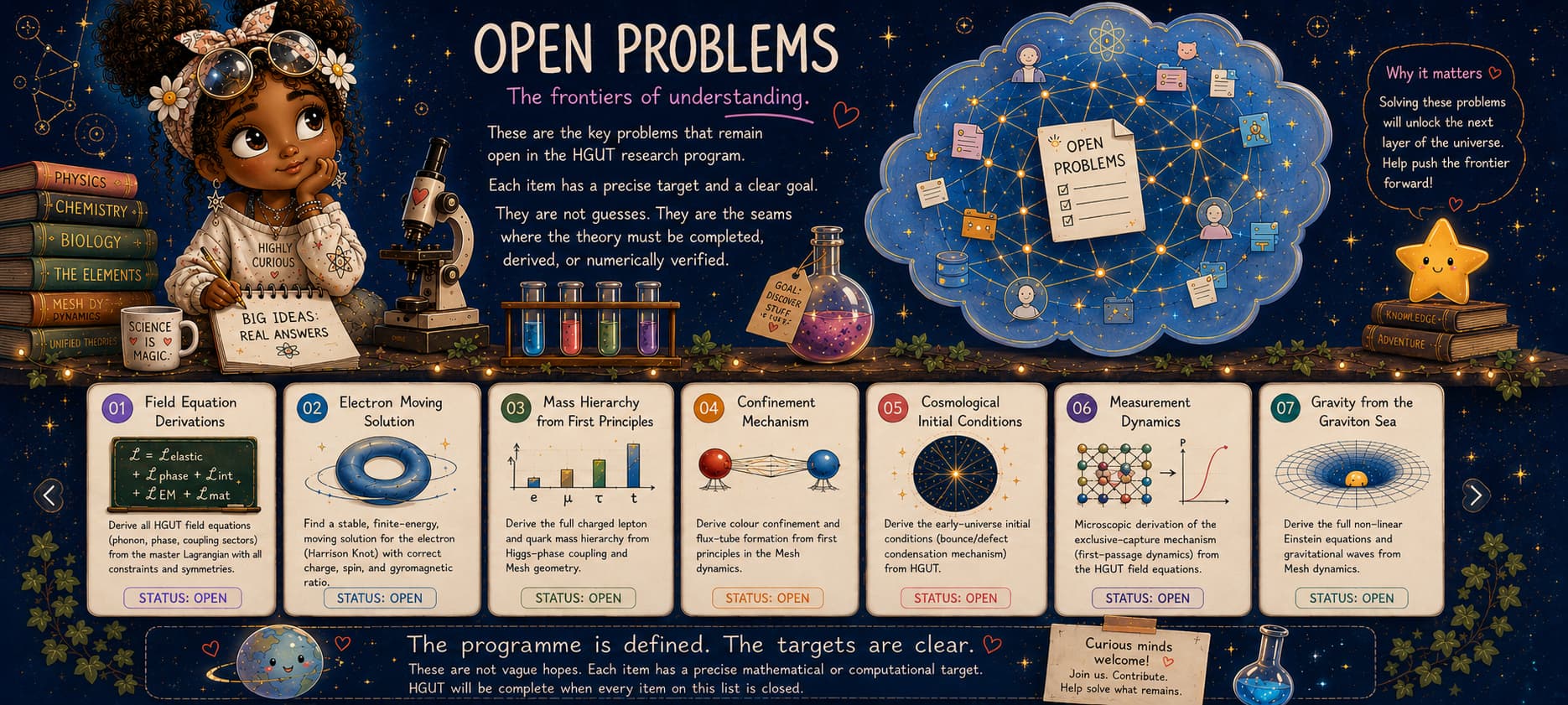
Open Research Programme
Welcome to the frontier.
Here are the adventures that remain.
Each problem has a precise target, a current status, and a clear path toward closure. Select a card to open the full research brief, dependencies, progress ledger, and contribution route.
Matter and Particle Closure
Electron Identity
Determine whether a stable, charged, finite-energy Q=1 Hopf-type Harrison Knot reproduces the complete physical identity of the electron.
Matter and Particle Closure
Proton Identity
Identify the proton's topological sector and derive its charge, mass, spin, stability, size, magnetic moment, and effective strong-interaction behavior from the HGUT substrate.
Matter and Particle Closure
Neutron Identity
Derive the neutron as a neutral massive topological structure and explain its spin, magnetic moment, free decay, nuclear stability, and relation to the proton.
Matter and Particle Closure
Particle Spectrum
Classify the stable and transient products permitted by Harrison-Knot topology and Great Collision debris, then recover the observed particle, interaction, mass, and decay spectrum.
Quantum Foundations
Measurement Closure
Derive definite outcomes, detector capture, basis selection, Born frequencies, entangled correlations, and causal post-measurement evolution without adding collapse as an independent rule.
Light and Transport
Nature of Light
Derive light completely as a transported HGUT process, including propagation, polarization, energy and momentum flow, interference, emission, absorption, and quantized exchange.
Quantum Foundations
Pauli Exclusion
Derive why identical electron knots cannot occupy the same complete quantum state and recover the many-electron exclusion structure from topology, exchange, and orbital corridors.
Atomic Structure
Orbital Transitions
Derive how electron knots change atomic orbitals, exchange discrete energy, obey selection rules, and produce the observed spectral lines within the Graviton Mesh.
Relativity and Causality
Lorentz Closure
Derive one operational Lorentz symmetry for matter, clocks, rods, phase propagation, and all observable HGUT modes while identifying or eliminating preferred-frame effects.
Relativity and Causality
Three-Speed Problem
Determine whether the transverse, longitudinal, and phase-related HGUT modes unify into one observable causal cone, decouple consistently, or produce falsifying Lorentz violations.
Time, Gravity, and Transport
Functionality Dynamics
Derive the field zeta(x,t) from the underlying medium variables and establish how strain, energy density, transport capability, and local clock progression determine its evolution.
Gravity and Emergence
Geometry and Functionality
Establish when medium functionality admits an effective geometric description, derive the metric and Einstein limit, and identify corrections beyond general relativity.
Foundations of Time
Sea Time Closure
HGUT has achieved foundational closure on the ontology of time: Sea Time is normalized substrate phase accumulation, Lab Time is the operational time accumulated by coherent structures, and the two are connected by the clock functional. The remaining work is derivational, dynamical, and empirical.
Quantum Gravity
Quantum Gravity Closure
Show that coherent topology sources emergent geometry, geometry modifies quantum evolution, both arise from one substrate, and the coupled system remains causal and conservative.
Strong Gravity
Black-Hole Interior
Determine the nonlinear interior structure of an HGUT black hole, whether functionality reaches zero, how information is preserved, and how matter and the medium evolve through saturation.
Strong Gravity
Two-Channel Distribution
Derive how infalling matter and energy divide between the Harrison Core and the surrounding gravitational or exhaust channel, including the exact nonlinear partition law.
Cosmology
Great Collision Dynamics
Simulate the collision of the pre-universe structures and determine whether the event produced a rebound, complete merger, partial merger, fragmentation, or another outcome.
Cosmology
CMB Interpretation
Derive the cosmic microwave background spectrum, anisotropies, polarization, acoustic structure, and large-scale anomalies from Great Collision initial conditions.
The programme is defined. The targets are clear.
Curious minds welcome.
These are not vague hopes. Each item has a mathematical, computational, or experimental closure condition. Join the work, challenge the assumptions, and help solve what remains.